Block Paving vs Resin Driveways in Derby: Which One Is Right for Your Property?
Resin and block paving are the two most popular driveway choices in Derby right now, and the question of which to go for comes up on almost every job we quote. They're both good options. They suit different properties, different budgets, and different priorities — and the right answer depends on what you're working with. This guide breaks down the real differences so you can make the decision with your eyes open, rather than based on whichever installer you spoke to last.
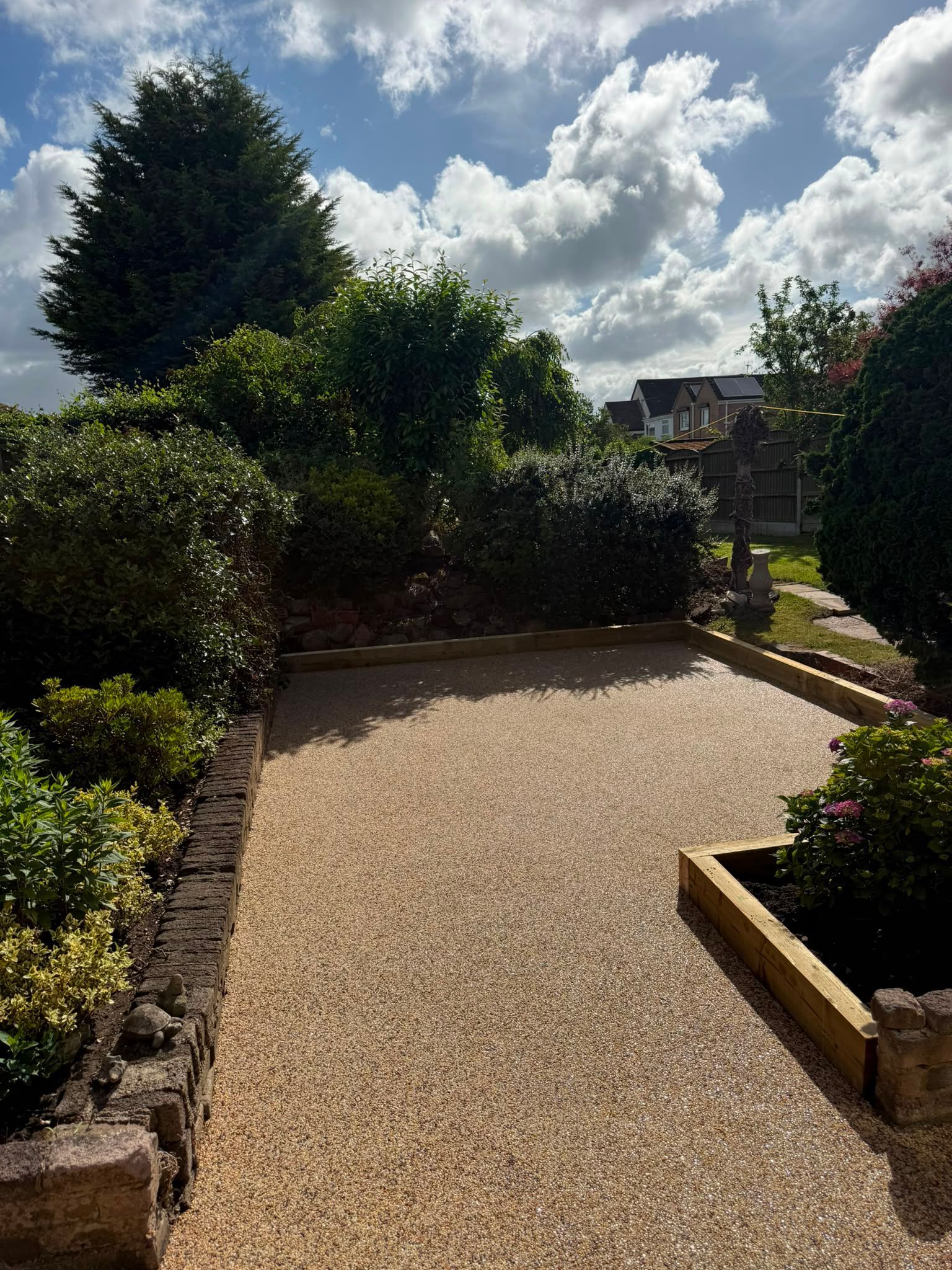
Block paving typically costs £50–£90 per square metre installed in Derby, depending on the block type and pattern complexity. A standard 40–50 square metre driveway on a Derby semi usually comes in at £2,500–£4,500. Resin bound runs slightly higher — typically £60–£120 per square metre — putting the same-sized driveway at £3,000–£6,000. The gap narrows on simpler jobs and widens on larger or more complex ones.
What you're paying for with resin is largely the material and the skill required to lay it correctly. Resin bound is mixed on site and poured to a tight time window. Get the mix wrong, lay it in the wrong conditions, or rush the finish and you end up with a surface that looks patchy within a year. Block paving is more forgiving to install, which is partly why there are more contractors who do it — and why prices are more competitive.
Both require a solid sub-base, and this is where Derby's ground conditions matter. Much of Derby sits on clay-heavy subsoil, particularly in areas like Normanton, Alvaston, and Chaddesden. Clay moves with moisture. A sub-base that isn't deep enough or properly compacted will let either surface sink or shift within a few years. Any quote that skimps on base depth on Derby clay is one to be wary of.
Resin bound has a smooth, contemporary finish. It comes in a wide range of aggregate colours and works well with modern builds, extensions, and properties with clean architectural lines. On a newer estate or a property that's been updated with rendered walls and aluminium windows, it tends to look the part.
Block paving is more versatile across property types. The traditional brick pattern suits Victorian and Edwardian terraces — of which Derby has a significant number, particularly around Normanton, the Arboretum, and parts of Pear Tree — far better than a smooth resin surface would. It can also be laid in more decorative patterns (herringbone, fan, double border) that add visual interest without looking out of place on older housing.
Neither is objectively better looking. It comes down to the property. A resin driveway on a period terrace can look clinical; block paving on a modern new-build can look dated. Most experienced installers will tell you the same.
Maintenance: What Each Surface Actually Needs
Resin bound is the lower-maintenance option day to day. No re-sanding, weeds struggle to take hold because there are no joints, and it sweeps and hoses clean easily. A seal every few years preserves the colour and protects against UV fade, but beyond that the upkeep is minimal.
Block paving needs more attention over time. The jointing sand between blocks gradually washes out — that's the main way weeds get established. Re-sanding every couple of years and applying a sealant keeps most of it under control. Individual blocks that sink or crack can be lifted and re-laid without touching the rest of the drive. That repairability is a genuine practical advantage, not a consolation prize.
Resin is harder to repair invisibly. If a section is damaged or a patch fails, blending a repair into the existing surface is difficult because the colour weathers over time. On a driveway that's a few years old, a repair patch will usually show. It's not a dealbreaker, but it's worth knowing before you commit.
Drainage and Planning Rules in Derby
Both surfaces can be made permeable, which matters for planning. Since 2008, laying an impermeable surface over more than 5 square metres of front garden requires permitted development consent. Resin bound, when installed over a permeable sub-base, is inherently permeable and automatically compliant. Block paving can be permeable if laid with permeable jointing or on a drainage sub-base, but standard block paving with sand joints and a solid sub-base is not.
If you're replacing an existing driveway in Derby, you're generally replacing like for like and planning is less of an issue. Converting a lawn or garden to driveway is where drainage compliance needs confirming before work starts. Derby City Council follows standard national guidance on this.
Which One Lasts Longer
A well-installed block paving driveway on a proper sub-base lasts 20–30 years before it needs significant attention. Resin bound, similarly well installed, typically runs 15–25 years. The overlap in those ranges is real — a poorly laid block paving job will fail faster than a well-laid resin surface, and vice versa. Lifespan depends more on the quality of the base and the installer than on the surface material itself.
Where block paving has a practical edge is repairability. If a section sinks after 10 years — not unusual on Derby clay if ground movement occurs — you lift, re-compact, and re-lay. If resin fails in a section after 10 years, you're either patching visibly or replacing a larger area to get a consistent finish.
FAQ
Q: Is resin or block paving cheaper in Derby? A: Block paving is usually cheaper, typically £50–£90 per square metre compared to £60–£120 for resin bound. The gap depends on job size, block type, and pattern complexity. Both require a solid sub-base, which is a significant part of the cost on either surface.
Q: Which driveway surface is better for an older property in Derby? A: Block paving generally suits Victorian and Edwardian properties better. The texture and pattern options complement period architecture in a way that a smooth resin surface often doesn't. For modern or recently updated properties, resin bound tends to look more at home.
Q: Do I need planning permission for a new driveway in Derby? A: Not usually, if you're replacing an existing hardstanding with a permeable surface or like-for-like. If you're converting a front garden and the new surface isn't permeable, you'll need to check permitted development rules with Derby City Council. Resin bound is inherently permeable; standard block paving may not be unless specifically specified.
Q: Which driveway is easier to maintain — resin or block paving? A: Resin bound needs less routine maintenance — no re-sanding, fewer weeds, easy to clean. Block paving needs re-sanding and occasional sealing but individual sections can be repaired without replacing the whole drive. Which is easier long-term depends on whether you'd rather do small regular jobs or avoid them entirely and accept that repairs are harder when they come.
Ready to work with Trade Smart Driveways & Landscaping?
Let's connect! We’re here to help.
Send us a message and we’ll be in touch.
Or give us a call today at 111-222-3333
Agency Contact Form
More Marketing Tips, Tricks & Tools